Faster setup
In many cases, rope access can be deployed faster than larger access systems that require extensive setup.

Rope Access Explained
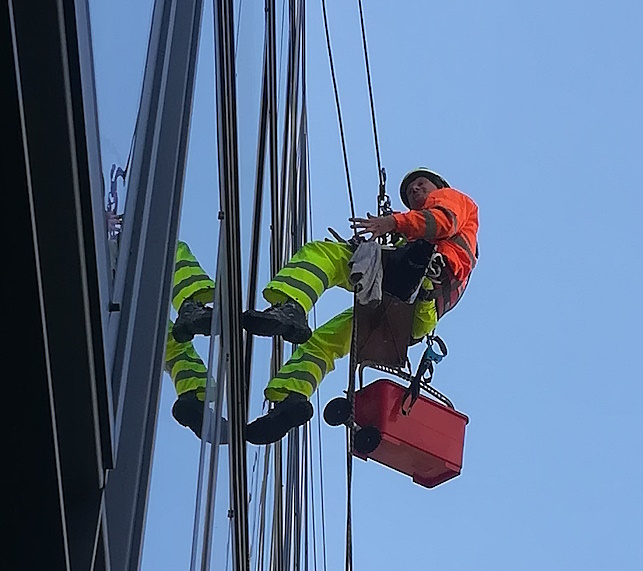
Rope access is a method of working at height using ropes, harnesses, anchors, and controlled positioning systems to reach difficult-access areas on buildings and structures.
It is commonly used for inspection, maintenance, repairs, cleaning, and other exterior work where direct access is needed and traditional access methods may be less practical.
Overview
Rope access allows technicians to work on facades, windows, joints, roof edges, and other hard-to-reach areas while suspended and secured with specialized equipment. It is widely used in building maintenance because it offers flexibility and direct access to the work area.
In cities like Toronto, where high-rise buildings and difficult-access exterior surfaces are common, rope access is an efficient solution for many types of building service work.
How It Works
Rope access work typically uses two independent rope systems: a working line and a separate safety line. These are anchored securely and used together with harnesses, helmets, descenders, ascenders, connectors, and other specialized equipment.
Technicians can move vertically and, in some cases, laterally across the structure while staying secured at all times. This makes it possible to reach work zones that may be difficult to access with scaffolding, lifts, or other traditional systems.
Why It Is Used
In many cases, rope access can be deployed faster than larger access systems that require extensive setup.
Technicians can often reach difficult facade areas more directly than with some traditional access methods.
The system allows efficient movement across selected exterior work zones and hard-to-reach surfaces.
Because the equipment profile is relatively compact, rope access can reduce disruption around some project sites.
Common Uses
Training and Certification
Rope access technicians require specialized training and certification to work safely and effectively. This includes equipment use, movement techniques, rescue awareness, and strict working-at-height procedures.
The method is not simply about using ropes. It depends on disciplined systems, competence, and consistent safety practices throughout the project.
Rope Access in Toronto
Toronto has a large number of mid-rise and high-rise buildings, along with many structures that require regular exterior maintenance. Rope access is well suited to this environment because it can support a wide range of cleaning, maintenance, and repair tasks on difficult exterior surfaces.
As the city continues to grow, rope access remains an important method for helping buildings stay clean, maintained, and operational.
FAQ
No. It is commonly associated with high-rise work, but it can also be used on other structures where direct exterior access is difficult.
Cleaning, inspections, repairs, maintenance, sealing, banner work, and other specialized exterior tasks.
Some projects benefit from a more flexible and direct access method, especially where setup time, reach, or site disruption are important factors.
Yes. It is widely used for many exterior building services in Toronto, especially on elevated and hard-to-reach surfaces.
Need Rope Access Services?
View our rope access services or send a quote request with your project details.